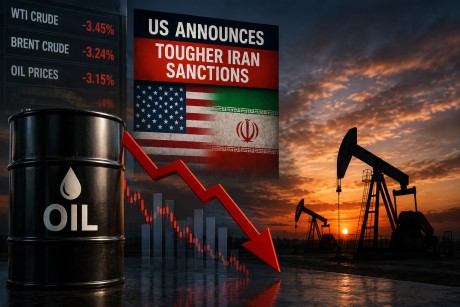
On Tuesday, oil prices took a significant hit, dropping over 3% to reach their lowest point in a week. This decline comes as investors weigh the potential consequences of newly imposed U.S. sanctions on Iran. The global oil benchmark, Brent crude, decreased by 3.1% to $89.31 per barrel, while the U.S. counterpart, West Texas Intermediate (WTI), saw a 3.34% reduction, settling at $82.17. This downward trend follows a period of robust gains in the previous week, where Brent climbed by 6.6% and WTI increased by 5.7%.
The U.S. has broadened its sanctions targeting entities and nations engaging in economic dealings with Iran. These measures are designed to exert further pressure on Tehran amidst ongoing tensions, with the goal of disrupting its economic stability. The oil markets remain particularly attentive to developments in the Strait of Hormuz, a crucial artery for global energy trade. Iranian authorities have issued warnings that oil exports through this strategic passage could be obstructed if Washington continues its pressure tactics.
Additionally, the risks associated with shipping have heightened following reports of a tanker being hit near the Musandam peninsula of Oman. These incidents, along with ongoing attacks in the Red Sea, have injected additional uncertainty into global energy supplies. Despite these geopolitical tensions, the focus for traders has shifted towards analyzing the impact of the new U.S. sanctions and whether they will substantially curtail Iranian oil exports.
While the geopolitical landscape continues to present challenges, the recent sanctions introduced by the United States serve to intensify the economic squeeze on Iran. As the oil market grapples with these developments, the potential for disruption in one of the world’s most vital energy corridors casts a shadow over future oil supply dynamics.